
How Does Tesamorelin Modulate Endocrine Dynamics Compared With Native GHRH?

How Does Tesamorelin Modulate Endocrine Dynamics Compared With Native GHRH?
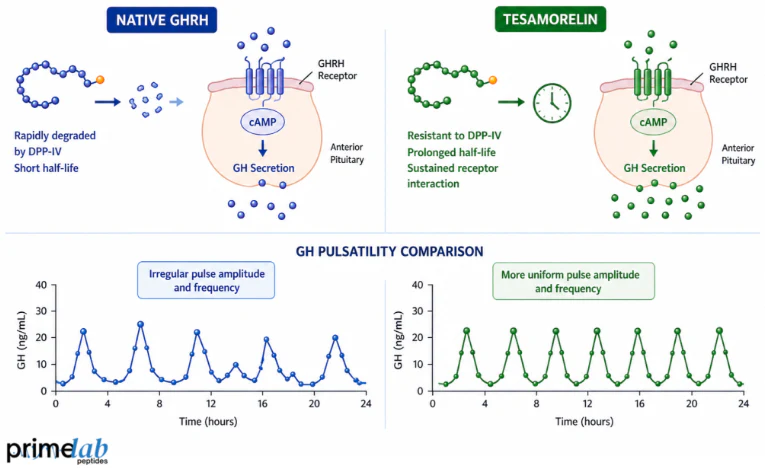
Tesamorelin modulates endocrine dynamics by replicating native growth hormone-releasing hormone (GHRH) activity while introducing structural modifications that enhance peptide stability and receptor interaction time. Native GHRH is rapidly degraded in circulation, resulting in short-lived signaling bursts. In contrast, tesamorelin resists enzymatic cleavage, thereby extending its biological activity and prolonging pituitary stimulation. Findings reported in the Pediatric Endocrinology Reviews demonstrate that stabilized GHRH analogs increase the consistency of GH pulsatility without altering receptor specificity or downstream signaling architecture.
Moreover, comparative endocrine models reveal that tesamorelin produces more uniform GH pulse amplitude and frequency across repeated stimulation cycles. This improved temporal stability enhances reproducibility in experimental settings, particularly when evaluating axis-level regulation. Importantly, tesamorelin preserves physiological feedback mechanisms, including somatostatin inhibition and IGF-1-mediated negative feedback, thereby maintaining endocrine equilibrium...