
Does MOTS-C Regulate AMPK Activity During Cellular Energy Stress?
News

Does MOTS-C Regulate AMPK Activity During Cellular Energy Stress?

MOTS-C regulates AMPK activity during cellular energy stress by acting as a mitochondrial-encoded signaling peptide that links intracellular energy imbalance to adaptive metabolic responses. Experimental evidence  shows that under glucose restriction or oxidative stress, MOTS-C enhances AMPK phosphorylation, promotes glucose utilization, and improves metabolic flexibility in skeletal muscle and hepatic models. It functions as a stress-responsive mediator that senses disruptions in the AMP/ATP ratio and amplifies AMPK signaling pathways. This activation leads to increased fatty acid oxidation, improved insulin sensitivity, and reduced metabolic inefficiency. In parallel, MOTS-C translocates to the nucleus, where it modulates transcriptional programs involved in cellular resilience and oxidative metabolism. Prime Lab Peptides supports mitochondrial signaling research by supplying rigorously characterized, research-grade MOTS-C produced under standardized analytical controls. Verified purity, structural confirmation, and batch traceability enable reproducible investigation of AMPK-dependent metabolic pathways and mitochondrial stress adaptation. Does...
Continue reading
How Does Tesamorelin Modulate Endocrine Dynamics Compared With Native GHRH?
News

How Does Tesamorelin Modulate Endocrine Dynamics Compared With Native GHRH?

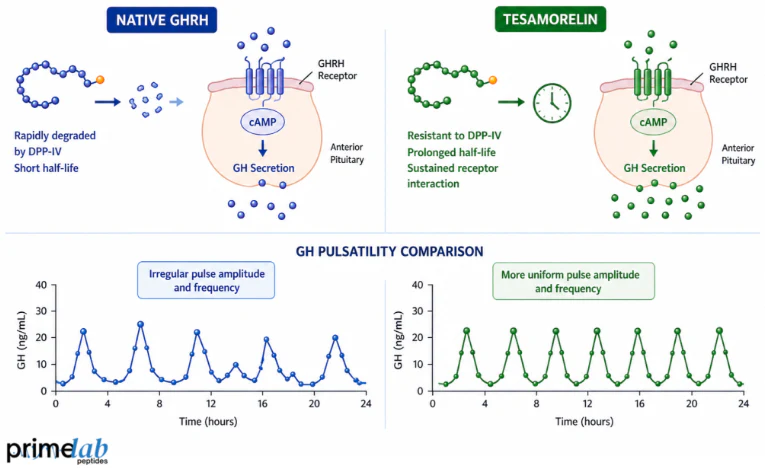
How Does Tesamorelin Modulate Endocrine Dynamics Compared With Native GHRH? Tesamorelin modulates endocrine dynamics by replicating native growth hormone-releasing hormone (GHRH) activity while introducing structural modifications that enhance peptide stability and receptor interaction time. Native GHRH is rapidly degraded in circulation, resulting in short-lived signaling bursts. In contrast, tesamorelin resists enzymatic cleavage, thereby extending its biological activity and prolonging pituitary stimulation. Findings reported in the Pediatric Endocrinology Reviews demonstrate that stabilized GHRH analogs increase the consistency of GH pulsatility without altering receptor specificity or downstream signaling architecture. Moreover, comparative endocrine models reveal that tesamorelin produces more uniform GH pulse amplitude and frequency across repeated stimulation cycles. This improved temporal stability enhances reproducibility in experimental settings, particularly when evaluating axis-level regulation. Importantly, tesamorelin preserves physiological feedback mechanisms, including somatostatin inhibition and IGF-1-mediated negative feedback, thereby maintaining endocrine equilibrium...
Continue reading
What Does Experimental Evidence Suggest About Selank as a Non-Sedative Anxiety Modulator?
News

What Does Experimental Evidence Suggest About Selank as a Non-Sedative Anxiety Modulator?

What Does Experimental Evidence Suggest About Selank as a Non-Sedative Anxiety Modulator? Experimental evidence strongly supports Selank as a non-sedative anxiety modulator by demonstrating consistent neurochemical regulation without central nervous system suppression under controlled laboratory and clinical conditions. Unlike traditional anxiolytics that induce sedation through receptor overactivation, Selank appears to influence endogenous regulatory systems, including peptide signaling pathways, monoamine balance, and integrated stress-response mechanisms across multiple biological levels. Clinical and preclinical findings consistently show that Selank modulates biochemical markers associated with anxiety while preserving cognitive clarity, alertness, and behavioral responsiveness in tested subjects. This distinction positions Selank as a regulatory agent rather than a suppressive pharmacologic compound, supporting its classification as a non-sedative anxiolytic candidate with measurable systems-level effects. Prime Lab Peptides provides researchers with analytically verified peptide compounds designed for controlled experimental applications and reproducible neurochemical investigations. Each...
Continue reading
What Role Does Ipamorelin Play in GH-Driven Body Composition Changes?
News

What Role Does Ipamorelin Play in GH-Driven Body Composition Changes?

What Role Does Ipamorelin Play in GH-Driven Body Composition Changes? Preclinical and translational endocrine studies explain ipamorelin precision by demonstrating selective activation of the growth hormone secretagogue receptor (GHSR-1a), resulting in controlled GH pulsatility linked to body composition changes. According to peer-reviewed analyses indexed in PubMed , receptor-specific peptides modulate somatotroph activity without broadly activating parallel endocrine axes. Within this framework, ipamorelin is consistently evaluated as a selective GHSR-1a agonist in models examining fat mass reduction, lean mass preservation, and metabolic partitioning under controlled physiological conditions. Prime Lab Peptides functions as a research-oriented supplier providing peptides with detailed specifications and analytical documentation. Consistent quality controls and transparent reporting support investigators addressing reproducibility, sourcing, and characterization challenges. Additionally, responsive technical communication helps researchers refine experimental approaches in peptide- and endocrine-focused laboratory studies. How Does Ipamorelin-Mediated GH Pulsatility Influence Body Composition Outcomes? Ipamorelin-mediated...
Continue reading