
Blogs

How Semax Affects Attention and Learning: Experimental and Clinical Insights

How Semax Affects Attention and Learning: Experimental and Clinical Insights
How Semax Affects Attention and Learning: Experimental and Clinical Insights Translational research defines cognitive resilience in Semax studies as the capacity of neural systems to maintain functional integrity under metabolic, oxidative, or ischemic stress through coordinated molecular adaptation. Instead of relying on behavioral outcomes, most investigations assess transcriptional reprogramming, synaptic gene recovery, and modulation of neurotrophic signaling in controlled experimental models. Evidence published in Cellular and Molecular Neurobiology  demonstrates that Semax activates neurotrophin and receptor gene expression following cerebral ischemia, supporting adaptive molecular responses. Importantly, translational frameworks emphasize pathway-level regulation rather than symptomatic outcomes. Through ischemia–reperfusion paradigms and transcriptomic profiling, studies evaluate Semax-induced modulation of calcium–cAMP signaling, neuroactive ligand–receptor interactions, and inflammatory gene networks. These coordinated molecular adjustments form the basis for resilience-oriented neural stability rather than direct cognitive performance claims. Prime Lab Peptides supports peptide-based investigations by supplying rigorously...
Continue reading
Blogs

What is The Role of Brainstem Amylin Receptors Cagrilintide in Metabolic Signal Integration?

What is The Role of Brainstem Amylin Receptors Cagrilintide in Metabolic Signal Integration?
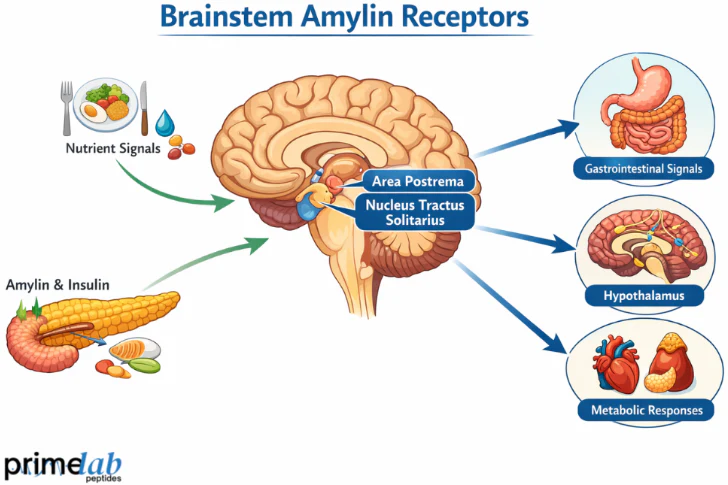
What is The Role of Brainstem Amylin Receptors Cagrilintide in Metabolic Signal Integration? Metabolic regulation depends on continuous communication between peripheral organs and central nervous system circuits. In this context, growing scientific attention is focused on brainstem amylin receptors, which serve as key neural sensors that integrate hormonal and nutrient signals. Moreover, these receptors coordinate satiety signaling, autonomic responses, and metabolic regulation. Therefore, understanding their function provides important insights into the neurobiology of appetite and systemic metabolic balance. At Prime Lab Peptide, we specialize in providing peptides of the highest purity, ensuring precise, consistent results across all batches. Our Cagrilintide formulations are designed to assist researchers exploring amylin receptor function, neural signaling mechanisms, and metabolic-neuroendocrine interactions. Through strict quality control and science-driven development, Prime Lab Peptide enables scientists to achieve dependable, evidence-based findings in peptide and metabolic research. How...
Continue reading